
The National Council of Applied Economic Research also says that the fiscal deficit will overshoot budget target to touch 4.7 per cent of GDP in 2004-05.
The government had no option but to cut spending to meet its borrowing targets.

While most experts suggest the government loosen its purse strings and not worry about the fiscal deficit in a pandemic impacted year, it will be a tightrope walk for the government to increase spending without going overboard.

'Interim Budget has ignited the entrepreneurial spirit.'

Rajeev Mehta, chief executive for IT services, believes this is due to a few client-specific issues, saying the overall business environment continues to look good.

The government has exhausted only 39 per cent of its fiscal deficit target in the first half of FY24.

The two-wheeler segment has shown signs of recovery in the first half (H1) of calendar year (CY) 2024, largely driven by improving performance in rural areas. According to the Federation of Automobile Dealers Associations, rural contribution to two-wheeler sales surged by 57-60 per cent in the April-June quarter of 2024-25, indicating a rising demand in these regions. Experts believe that this trend will continue, supported by a favourable monsoon season and government initiatives aimed at rural development.

Chief executive officers (CEOs) across sectors have expressed intentions to expand capacities, expecting the government's target to invest a record Rs 11.11 trillion on infrastructure development will act as a catalyst for a jump in consumer demand. "With the government planning a capex of Rs 11.11 trillion, private sector investment will come in a big way. Companies will be preparing for it right from today," H M Bangur, chairman of Shree Cement, told Business Standard. For the past few years, the investment scene in India has been dominated by government capital expenditures; private investments in the manufacturing sector have remained muted.

If there is no third wave of the pandemic, the fiscal position of the Centre and the states will be much better than budgeted for FY22 and the states may garner Rs 60,000 crore more in tax collections at Rs 8.27 lakh crore this fiscal year than they have budgeted, a report said. The report by SBI Research on Monday bases its optimism on GST collection so far this fiscal, which has been the best ever in spite of the fact that the two months bore the maximum brunt of the second wave -- with April setting a record Rs 1.41 lakh crore and May collection a tad low at Rs 1.03 lakh crore. The report also said overall government finances do not look overstretched as GST collections have continued to maintain pace so far and the additional fiscal impact arising from free vaccination and more food supplies will only be around Rs 28,512 crore.
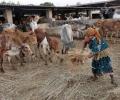
The Budget allocation for Ministry of Agriculture and allied activities has grown by 114% since 2010-11

'The finance minister in her Budget speech should spell out how exactly she intends to get back to the 7% track, and the hard decisions she intends to take in order to adjust to the realities of a slowing economy until growth momentum returns,' suggests T N Ninan.

For 2017-18 and 2018-19, investors are better off focusing on the quality of measures announced in the Budget and outside it rather than on the Budget numbers themselves, says T T Ram Mohan.

Moody's Ratings on Tuesday said India's growing water shortage can disrupt farm and industry sectors and is detrimental to the credit health of the sovereign as rising food inflation and decline in income may spark social unrest. It said decreases in water supply can disrupt agricultural production and industrial operations, resulting in inflation in food prices and hence can be detrimental to credit health of sectors that heavily consume water, such as coal power generators and steel-makers.

'The private sector believes that some enablers in labour-intensive sectors like apparel, toys, tourism, and media retail, can unlock a lot of jobs.'

After the Covid-19 pandemic that derailed the economy since 2019, the Durga Puja festival in West Bengal is back with an estimated 20-30 per cent jump in festive spending. Retail sector is the key contributor to the state's Durga Puja economy which was Rs 32,377 crore in 2019, according to a British Council study conducted for the state government. Retail accounts for 85 per cent of the total puja economy and the rest is shared among pandal making, decoration, illumination, entertainment, advertisement, food & beverage and others.

'Personal income tax is growing by 27 per cent and most refunds have already been issued.'
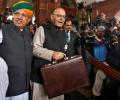
Pensioners, India Inc may get tax breaks in Budget
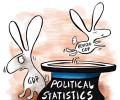
The Economic Survey 2022-23 (FY23), to be presented a day before Union Budget 2023-24 (FY24), is likely to project India's real gross domestic product (GDP) growth between 6 per cent and 7 per cent for FY24, Business Standard has learnt. The broader theme of the Survey could be on how India has dealt with two years of a global pandemic and the ongoing geopolitical disturbance, the strengths and weaknesses that emerged, and what lessons may be learnt. The much-awaited Survey will be the first one by Chief Economic Advisor V Anantha Nageswaran and his team in the finance ministry's economic division.

The government had breached its fiscal deficit target given in the Budget for 2017-18 in November itself, touching 112 per cent of the limit.

Sliding for the fifth straight session, the rupee fell 3 paise to close at a fresh lifetime low of 79.06 against the US dollar on Thursday amid a strong greenback overseas and unrelenting foreign fund outflows. At the interbank forex market, the local unit opened at 78.92 against the greenback and witnessed an intra-day high of 78.90 and a low of 79.07. It finally settled at 79.06, down 3 paise over its previous close of 79.03.
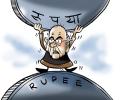
Fiscal deficit in first half of FY19 has already reached 95.3 per cent of full-year budget estimates.

Finance Minister Nirmala Sitharaman on Friday pitched for front loading of capital expenditure, saying it is critical for revitalisting the economy post the coronavirus pandemic. During a virtual meeting with senior government officials to discuss the infrastructure roadmap ahead, she also asked ministries to aim to achieve more than their capital expenditure (capex) targets. The Union Budget 2021-22 provided a capital outlay of Rs.5.54 lakh crore, a sharp increase of 34.5 per cent over the Budget Estimate of 2020-21.

Foreign portfolio investors have been net positive since the Union Budget

The final Budget for the fiscal is likely to be tabled in July after formation of the new government.

The Union Government's fiscal deficit remained above the annual target for second month in row at the end of August, mainly on account of the impact of lockdown on revenue collections. According to the data released by the Controller General of Accounts (CGA), fiscal deficit during April-August was at 109.3 per cent of the annual target estimated in the Budget.

Do the actual numbers bear out the claims made by the government or do they suggest something else? asks A K Bhattacharya.

The government on Saturday allocated Rs 2826.92 crore to the sports budget for the next financial year, which is up by a mere Rs 50 crore from the revised estimates of 2019-20. The government gave a substantial hike of Rs 291.42 crore to its flagship Khelo India programme for development of sports at the grassroot and youth level, which meant that most of the other heads got reduced allocation in an Olympic year.

The Budget is remarkably coherent.

Samajwadi Party chief Akhilesh Yadav said his party would oppose the Centre's move to bring a bill in Parliament to amend the 1995 law governing Waqf boards, and accused the BJP of trying to snatch the rights of Muslims.

IThe fiscal deficit target for 2020-2021 was originally set at 3.5 per cent of GDP. But the government's revenues have collapsed and its expenditure burden will only increase over the Budget estimates.' With the government having already planned for an additional borrowing of over Rs 4 trillion, the fiscal deficit for the current year would be much higher than the Budget estimate, notes A K Bhattacharya.
'The Budget numbers presented severely underestimate the magnitude of the unstated fiscal crisis that we went through in 2018-2019, which cannot be conceivably be fully reversed in 2019-2020,' points out Rathin Roy, director, National Institute of Public Finance and Policy.

"The Union Budget represents the aspirations of 130 crore Indians and lays out the path towards India's development. I invite you all to share your ideas and suggestions for this year's Budget on MyGov," the PM said according to a statement posted on his official website on Thursday.

By taking the mutual fund route, investors can take exposure to gilts with small amounts. Over a decade or more, returns from these funds tend to be sound.

Expressing commitment to augment the country's infrastructure, Finance Minister Nirmala Sitharaman on Monday proposed to significantly enhance capital expenditure to Rs 5.54 lakh crore in the next fiscal, besides creating institutional structures and giving a big thrust to monetizing assets to achieve the goals of the National Infrastructure Pipeline (NIP). Sitharaman said NIP, that was launched in December 2019 with 6,835 projects, has now been expanded to 7,400 projects and around 217 projects worth Rs 1.10 lakh crore under some key infrastructure ministries have been completed. "For 2021-22, I propose a sharp increase in capital expenditure and thus have provided Rs 5.54 lakh crores which is 34.5% more than the BE of 2020-21," the finance minister said.

After some enforced slowdown in offtake during April-May 2024 due to elections, the cement sector is looking at a possible demand rebound which may help it to push up prices. The April'24 offtake was muted while May'24 saw some improvement with a likely 5-6 per cent rise in demand month-on-month (MoM). In June, some price hikes seem to have been taken, which suggests more sustained improvement in demand.

The amount allocated for 2019-20 is 11 per cent higher compared to Rs 55,000 crore allocated for the year 2018-19.

The challenge of achieving fiscal deficit targets for the next two years seems daunting.
In recent years, excise duty collections had always played truant to the expectations.

The government also proposed promoting 'one product one district' for better marketing and export of horticulture crops. It also called on states for early implementation of three key central model laws on land leasing, agriculture produce and livestock marketing and contract farming.
